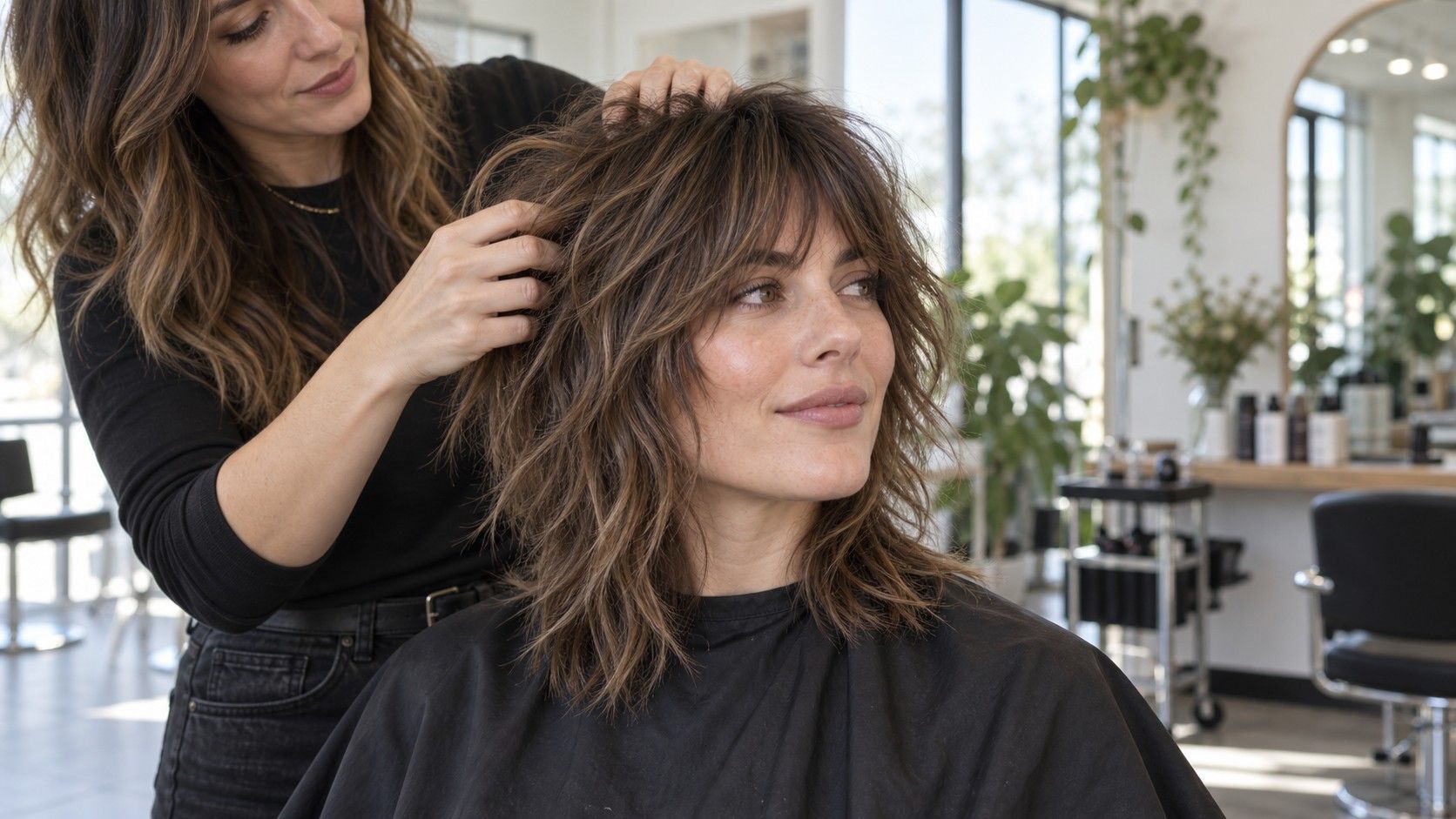
A shag haircut is built from layers, but a modern version should not feel like a pile of random short pieces. It has a plan: lift near the crown, movement through the mid-lengths, and an outline that still makes sense when you skip a blow-dry. Before asking for one, decide how much texture you enjoy seeing, how much density your hair has, and whether your normal routine is closer to air drying than a salon finish.
What makes a modern shag different
The older, more dramatic idea of a shag often meant a very short crown, heavy feathering, and a deliberately wild finish. A modern shag haircut can still be bold, but it usually uses longer transitions. The shortest crown layers are connected to the lengths instead of sitting like a separate cap. That connection matters when the hair moves, when the wind catches it, and when you pull the front behind your ears.
Look at the perimeter, not only the face-framing layers. A well-shaped shag can have a rounded baseline, a lightly shattered edge, or longer back sections, but it should not end in a row of thin tails unless that is a conscious choice. The perimeter carries the apparent density. When it is over-layered, medium or fine hair can look much less substantial than it did before the appointment.
Fringe is common but optional. Curtain bangs blend into a shag easily because they can travel into cheekbone layers. A full fringe creates more contrast and needs more regular trimming. If you do not like hair near your eyes, tell the stylist early. A shag hairstyle with a fringe that you keep pinning back is not low maintenance; it is a shape working against your habits.
Decide how much texture you want
Texture comes from both the cut and the finish. Point cutting can soften ends while keeping enough weight for the hair to clump naturally. A razor cut creates a more broken edge and can be beautiful on healthy, medium-to-thick hair, but it is not automatically better. On brittle, heavily lightened, or very fine hair, aggressive razor work can make the ends look feathery in a way that reads as damage rather than movement.
At the consultation, use practical language. Say whether you want to see distinct layers in a mirror, whether you want the hair to look fuller at the crown, and whether you like a polished or undone edge. Bring one reference for shape and one for texture. A photo of loose waves may be showing heat styling, not a cut that will appear on your naturally straight hair after a shower.
Density changes the formula. Thick hair can handle internal weight removal, although removing too much can produce a puffier halo. Fine hair often needs fewer, longer layers and a stronger line at the ends. If your hair is medium density but wavy, ask where the layers will spring once dry. Measuring every section wet without allowing for shrinkage is how a promising shag turns unexpectedly short around the face.
| Texture level | Cut approach | Daily reality |
|---|---|---|
| Soft | Longer layers and a fuller perimeter | Easy to smooth or air dry |
| Medium | Visible crown layers with blended ends | Needs a little product for separation |
| High | Strong contrast, broken fringe, more internal removal | Best for people who enjoy styling variation |
Shag cuts for straight, wavy, and curly hair
Straight hair shows every line, so a shag needs careful blending. A few short layers at the crown can create lift, but too many can stick out without a bend from a dryer or iron. If you want to air dry straight hair, keep the difference between the crown and lower layers moderate. A side part and a little root lift can make the shape look intentional without asking the hair to do something it does not naturally do.
Wavy hair is often the easiest match because it gives the layers their own movement. The important question is whether the wave starts near the root or below the ear. Waves that begin low may need a little more crown structure; waves that begin high can become triangular if the sides keep too much weight. Let the stylist see your hair dry in its usual state if possible, rather than arriving with every wave brushed out.
A curly shag needs a curl-by-curl view of volume. Curly hair can shrink significantly, especially at the crown and fringe, so a dry or mostly dry assessment is valuable. Short crown layers can create wonderful roundness, but they can also push all the volume upward if the lower lengths are too sparse. The best curly shag leaves room for the curl pattern instead of thinning it until it loses definition.
Style the shape without overworking it
Start with the product that solves your actual problem. If your hair is soft but flat, use mousse at the roots and a light spray through the lengths. If it is wavy and prone to frizz, use a curl cream or gel, then stop touching it while it dries. If it is thick and expands, a small amount of smoothing cream on the mid-lengths is usually more useful than piling wax around the crown.
For an air-dried shag, apply product to damp hair, twist a few face-framing pieces in the direction you want, and leave the rest alone. Once it is dry, separate only the pieces that have joined into bulky sections. Constant scrunching after the hair has dried creates frizz and makes the layers appear shorter. A wide-tooth comb is useful before product; a small amount of finger work is more useful afterward.
When you want a more finished result, dry the fringe first because it sets quickly. Then lift the crown with a round brush or simply direct the roots upward with your hands and a dryer. Add a little bend to the mid-lengths, alternating the direction so the result does not resemble a uniform wave. The point is movement between layers, not a perfect curl pattern from root to tip.
When a shag may be too high-maintenance
A shag can be low effort, but it is rarely no effort. A pronounced fringe needs attention every morning, and a short crown can lose its shape faster than a one-length cut. If you only wash your hair twice a week and do not like refreshing products, choose longer layers with a softer fringe. They will still give a shag-like feel while allowing a ponytail or a clipped-back day when needed.
Consider your climate and your hair history. Humidity can make very texturized hair swell, while dry weather can make heavily layered ends look thirsty. If you regularly bleach your hair, leave enough length at the perimeter to protect the appearance of fullness. A modern shag haircut should make styling more interesting, not force you into daily heat work to disguise fragile ends.
Maintenance is also about communication. Book a reshape before the cut grows into a completely different silhouette, usually around eight to twelve weeks depending on length and fringe. At that appointment, say what happened at home: whether the crown fell flat, the sides became bulky, or the fringe separated. Those observations are more useful than requesting ‘more layers’ again. A good shag haircut gets better when its next adjustment responds to your real routine.