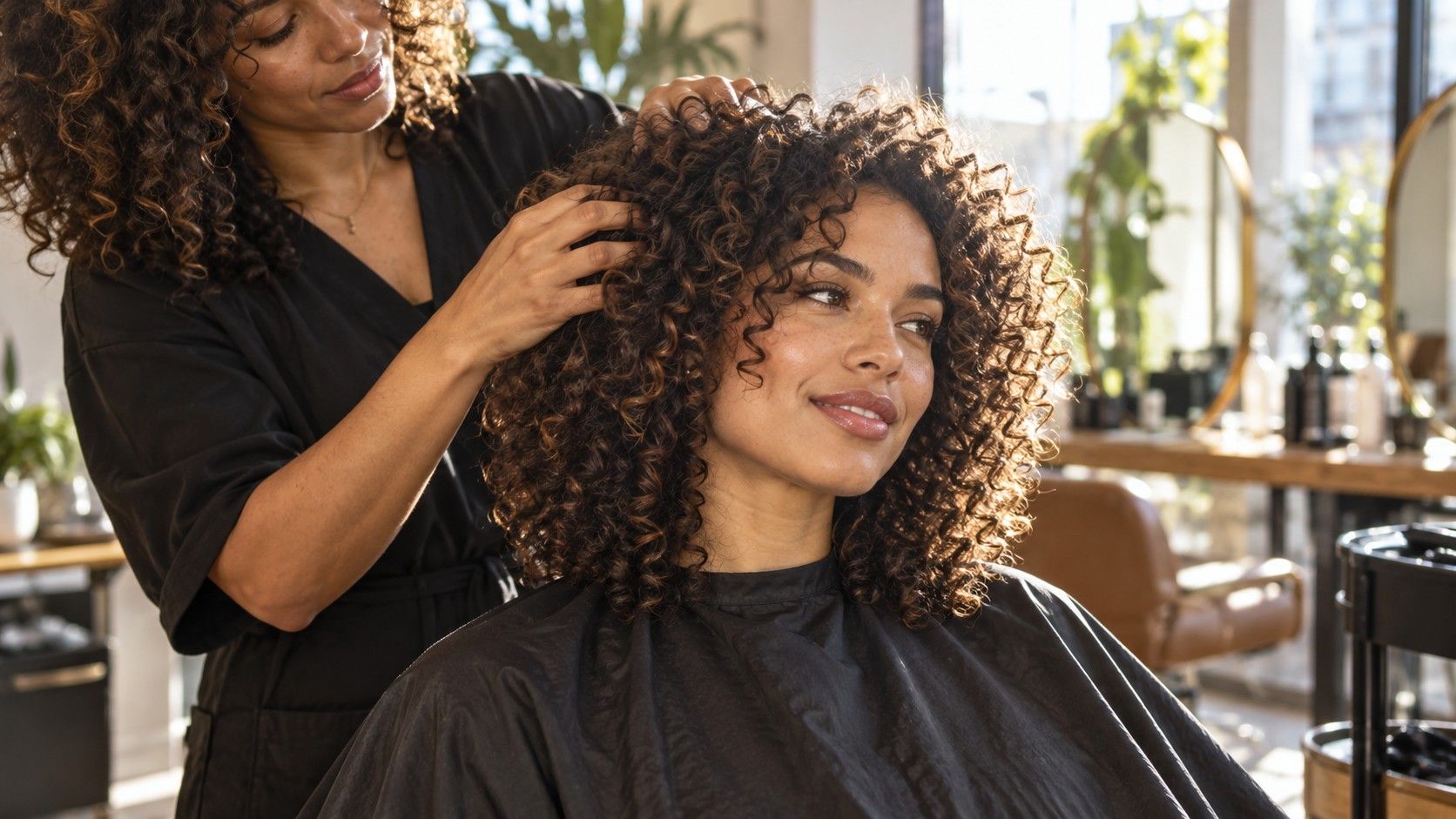
The best hairstyles for curly hair begin with the shape your curls make on an ordinary wash day, not the smoothened version seen in a salon mirror. Curls have their own geometry: some spring upward, some widen at the sides, and some change character between the nape and the crown. A useful cut works with that variation and leaves enough room for the hair to move without becoming an uncontrolled triangle.
Read the pattern, density, and shrinkage before choosing a shape
Curl pattern matters, but density and shrinkage often matter more. Two people with loose spirals can need completely different cuts if one has a dense crown and the other has fine hair that expands only at the sides. Look at the hair when dry and settled. Notice where it is fullest, where it drops, and how much shorter it becomes from wet to dry. That tells you whether the cut needs internal space, a stronger lower edge, or a little height at the crown.
Shrinkage deserves a direct conversation before scissors come out. Hair that sits at the collarbone when wet may rest well above the shoulders once dry. Bringing photos helps, but bring photos of texture similar to yours and say whether you normally diffuse, air-dry, or stretch the hair. A reference with loose, glossy waves will not predict the result on dense, tight curls, even if the outline looks appealing.
Pick a silhouette rather than chasing a named trend
Names such as shag, wolf cut, or curly bob can be useful shorthand, but they do not answer the important question: where should the volume sit? A rounded shape suits someone who likes width around the cheeks and a soft halo. A longer oval silhouette keeps more length below the jaw and can make the sides feel calmer. A compact curly bob puts the focus on the face, but it needs enough room at the crown so it does not become boxy as it grows out.
Ask to see the outline from the side and back, not just from the front. Many curly haircut ideas look balanced straight on yet develop a shelf at the occipital bone or a thin tail at the nape. A good cut has a reason for each area of length. It should not rely on pulling the front forward to hide an uneven back, and it should still resemble itself after you separate the curls with your own hands.
| Goal | Useful shape choice | Question to ask at the chair |
|---|---|---|
| Less side width | Longer oval with controlled layers | Where will the widest point land when dry? |
| More crown height | Rounded layers near the top | Will these pieces lift without exposing the scalp? |
| Easy short style | Curly bob or cropped rounded cut | How will the nape grow in over six weeks? |
| Keep length | Long layers with face framing | Which length must remain solid at the bottom? |
Understand when layers add life and when they add frizz
Layers let curls stack instead of forming one heavy curtain. They are especially useful when the crown is flat but the lower half becomes bulky, or when dense hair needs air between curl clumps. The problem begins when the layers are too short, too numerous, or cut with the same formula everywhere. Short pieces can pop out around the temples, and over-layering can leave the perimeter weak enough that every humid day looks unfinished.
For medium and long curls, it is often safer to build a few deliberate levels than to ask for lots of texture. A curl-by-curl approach can help a stylist see which ringlets spring higher and which sections need to stay long, but it is not magic by itself. The result still depends on clean sectioning and a clear final silhouette. If your hair is fine, keep a substantial bottom layer; otherwise the extra movement may come at the cost of fullness.
Talk plainly about dry cutting, wet cutting, and the first wash
A dry cut can be useful because the stylist sees the curls at their real length and can respond to uneven shrinkage. It is not automatically the only correct option. Wet cutting can also work when it is followed by careful dry shaping, particularly for a larger change where clean sections are easier to establish damp. What matters is that the appointment includes a final look at dry, natural texture before you leave.
Be specific about the first wash at home. Ask which pieces may need to be twisted, which should be left alone, and how much product was used to create the salon definition. Freshly cut curls often need one or two wash cycles to settle, but a dramatic mismatch should not be dismissed with vague promises. Take a few photos in the same lighting before and after the wash; they make it easier to describe whether the issue is length, imbalance, or a fringe that shrinks too high.
Keep the cut recognizable between wash days
A curly style is only successful if it works on day two and day three, when you are refreshing rather than starting over. Preserve the curl clumps that still look good. Mist only the flattened areas, smooth a small amount of lightweight product over the surface, and reshape individual front pieces with wet fingers if needed. Saturating the entire head each morning usually trades one problem for another: prolonged drying time and a softer, less defined finish.
A diffuser helps when you want volume without disturbing the pattern, but use low to medium heat and pause rather than constantly stirring the hair. Hold sections in the diffuser bowl, then let them cool before separating. If frizz appears mainly at the crown, check whether you are touching it while wet or whether the top layers are simply too short. More product is not always the answer; sometimes a slightly longer crown shape is the practical fix.
Choose curly styles that fit your actual routine
The best haircut for curly hair matches the maintenance you can repeat. A sculpted rounded cut may need regular shaping and a consistent diffusing routine. A longer layered shape can be more forgiving if you air-dry, but it may take longer to look intentional after sleeping on it. Neither choice is superior. It is better to choose a style that behaves well in your climate, under a hood, and on the mornings when wash day is not possible.
Before your next appointment, save two kinds of evidence: pictures of your hair on its best ordinary day and pictures of the part that frustrates you most. Those are more informative than a folder of unrelated trend photos. Tell the stylist where you want softness, where you can tolerate volume, and whether you ever wear the hair pulled back. That conversation produces a cut with a purpose, rather than a pretty result that disappears as soon as you use your own shampoo and towel.