The most useful easy updo hairstyles are not the ones that look immovable in a photograph. They are the ones you can put together with an ordinary elastic, a handful of pins, and a mirror that is not especially flattering. A good updo should survive a commute, dinner, a warm room, and the moment you tuck one loose side behind your ear without needing a complete rebuild.
Prepare hair so an updo has something to hold on to
Freshly washed hair can be beautifully soft and unexpectedly slippery. If you have ever watched a bun slide down within an hour, that is usually the reason rather than a lack of pins. Hair with a little natural oil, day-two texture, or a light mist of texture spray has more friction. The goal is not to make it stiff; it is to stop smooth strands from escaping every time you turn your head.
Start with a part that you would genuinely wear. A centre part can make a low bun feel clean and modern, while a soft side part gives face-framing pieces somewhere natural to fall. Brush only enough to remove knots. Over-brushing creates a glossy surface that pins struggle to grip. For very fine hair, make two loose ponytails at the nape, twist each one, then join them; the extra elastic gives the finished shape a hidden anchor.
Choose a low bun when you want polish without a severe finish
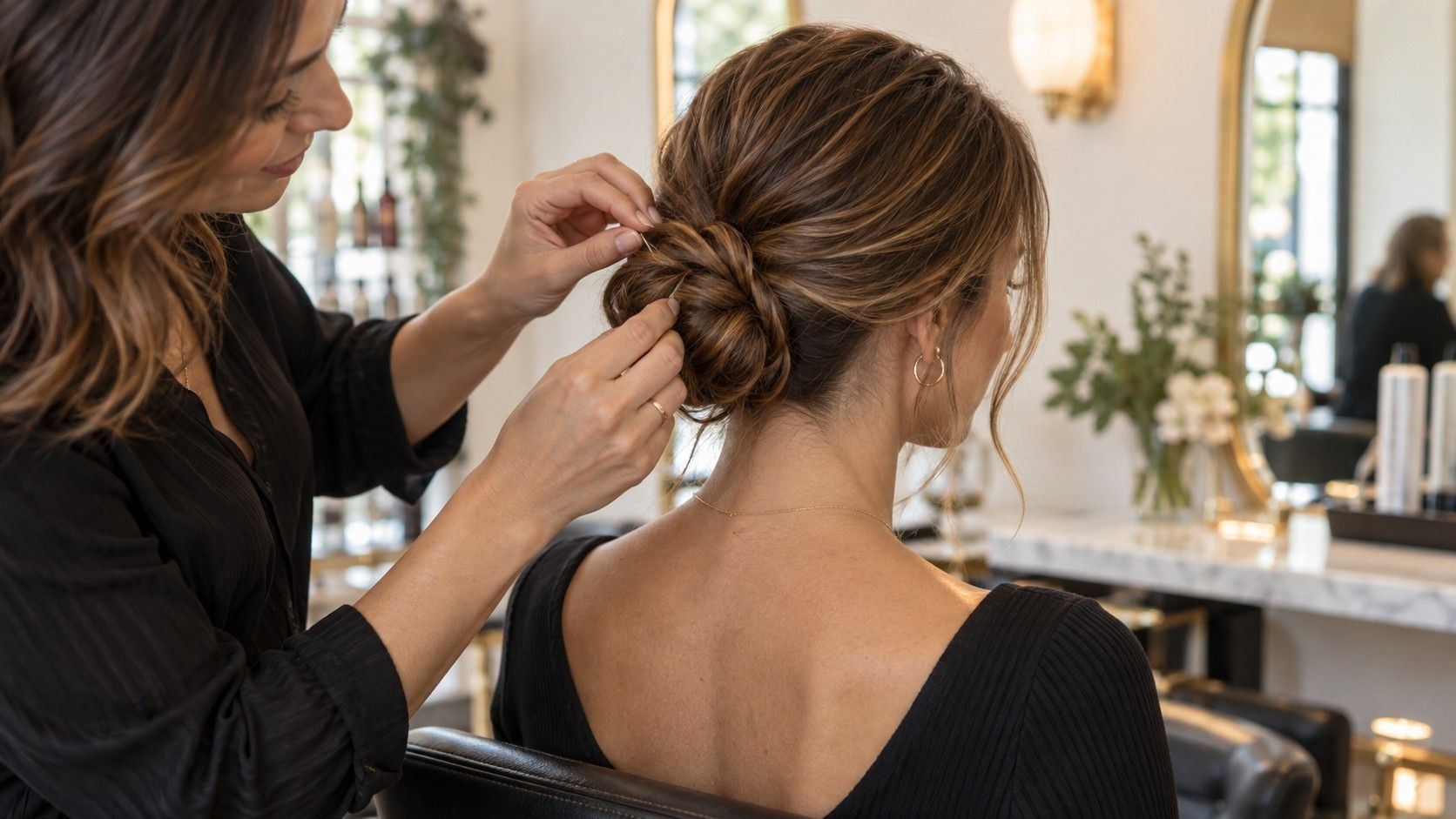
A low bun is one of the simplest updo ideas because its position does much of the work. Place the ponytail at the nape rather than high on the head, then leave a little softness around the crown before tightening the elastic. Twist the ponytail once or twice, wrap it around the base, and pin into the elastic rather than only into loose hair. That small detail makes the bun feel secure without pulling at the scalp.
For a fuller bun, gently pull apart the wrapped coil before adding the final pins. Do this in tiny sections: a large pull creates a lopsided loop that is hard to hide. If the style looks too formal, loosen the hair just above the ears and release two narrow face-framing pieces. If it looks too casual, smooth only the underside at the nape with a pea-sized amount of styling cream. A low bun works especially well with a blazer collar, a high neckline, or earrings that deserve a clear view.
Turn a basic ponytail into a deliberate updo
A ponytail becomes an updo when it has a shape beyond the elastic. One reliable approach is the tucked ponytail. Make a low ponytail, create a small opening just above the elastic, and flip the tail through it from top to bottom. The first turn gives you a soft twist at the nape; a second turn shortens the length and creates a compact roll. Secure the remaining ends underneath with crossed pins, keeping the open side of each pin toward the scalp.
Another option is a looped ponytail. Pull the hair through the elastic only halfway on the last wrap, fan the loop slightly, and wrap a small end section around the elastic. This is useful when time is short, but it benefits from controlled tension. If the elastic is too loose, the loop drops; if it is too tight, the top looks pulled and uncomfortable. A fabric-covered elastic is kinder to hair, while a small clear elastic can disappear neatly under a wrapped section.
| Situation | Simple shape | Best anchor |
|---|---|---|
| Fine hair that slips | Two-piece low bun | Two elastics at the nape |
| Shoulder-length hair | Tucked ponytail roll | Crossed pins under the twist |
| Long, thick hair | Rope-twist bun | Large U-pins through the base |
| Very little time | Looped ponytail | Firm elastic and one hidden pin |
Add braids or twists when you need more grip
Braids are useful in updo hairstyles because they reduce the amount of loose hair you need to control. A loose three-strand braid at each side can be brought back to meet a low bun, covering the base and making the style look more intentional. Keep the first few braid stitches close to the head, then relax the rest with your fingertips. A braid that starts loose often sags at the temple before the evening is over.
Twists are easier if braiding is not your habit. Take a section from just above one ear, twist it away from your face, and add a little more hair as you travel toward the nape. Repeat on the other side and secure both twists over a small bun. The direction matters: twisting away from the face keeps the front open, while twisting toward it can make the sides collapse inward. On layered hair, expect short ends to appear; pin them where they land instead of repeatedly tightening the entire twist.
Use a claw clip for a relaxed style that still has structure
A claw clip updo can look effortless, but the clip size has to match the amount of hair. A tiny clip on thick hair will hold for a few minutes and then lever itself open. Gather hair into a low ponytail with your hand, twist the length upward, fold the ends down, and place the clip vertically over the twist. The teeth should catch both the twist and the hair near the scalp. If they only grip the outer coil, the style will feel loose immediately.
For shorter or heavily layered hair, leave the ends out on purpose rather than forcing them under the clip. That gives a soft French-twist outline and avoids a strained, spiky finish. Check the profile view before leaving home: a clip placed too high can push the crown forward, while one at the nape is usually more comfortable against a car seat or sofa. A neutral clip disappears into the look; a glossy tortoiseshell or metal clip can be the only accessory you need.
Make the style last through an event without freezing it in place
The last five minutes decide whether an updo feels wearable. Move your head from side to side, look down as if checking a phone, and lift your shoulders as if putting on a coat. If a pin bites, move it now. If the crown has become flat, lift one thin section with the end of a comb rather than tugging the whole style. Hairspray is best used as a light final veil from a distance, not as a substitute for an elastic and pins placed well.
Carry two spare pins and one small elastic if you are going somewhere that matters. They weigh nothing and solve most problems: a face-framing piece starts to droop, a braid loosens near the nape, or a bun needs a single extra anchor after dinner. The strongest easy updo is not perfectly smooth. It has balanced tension, a little movement near the face, and enough security that you stop thinking about your hair once the evening begins.